• Words, words, words…

    Words, words, words…

    “Everyone should write a book about Shakespeare.”

    From The Hollow Crown by Elliot Cohen

    I was working out a few weeks ago and listening to a podcast, and I think one of the hosts referenced the line from Hamlet.. “Words, words, words…”

    It could have been something else from Shakespeare – or something else entirely – but it made me think of that line, which I’ve always loved and frequently reference.

    For whatever reason, on that morning, it made me realize that I actually haven’t read much Shakespeare.

    A little bit in high school (The Merchant of Venice) and college (Much Ado About Nothing), but not much on my own. I’ve seen many of the movies (Romeo and Juliet, A Midsummer Night’s Dream, Macbeth) in their various forms, but I can’t say that I’m well versed.

    Incidentally, I also haven’t written much here for awhile.

    If you’ve been on the journey with me, you know I’ve gone back and forth with writing here, usually as life ebbs and flows, and requirements dictate where I can put my energy.

    Well, I’ve missed writing, and I’ve missed the opportunity to interact with material. So during that work out I jotted down that maybe I could look at getting back to writing and using Shakespeare as a way to get me here.

    So that’s what I will be doing. The plan is to read the complete works of Shakespeare, slowly, and write about. That’s it.

    As has always been the case with this blog, it’s here mostly for me – a space to write and to think. Right now, this is where my comfort level is. And I’m happy to have any comfort at all.

    In the future, I’ll hit the switches and bring back the old stuff, which I really like. And I hope to write again in a more general nature. But for the time being, this is where I’m at. I hope you enjoy it.
    Leave a comment


  • Sparkly Eyes Technique

    Sparkly Eyes Technique

    How can it be all right there, yet seemingly not understood?

    Because there is the truth of fact, and the truth of feeling. And they are never in balance.

    This is one of the most consequential stories I’ve read in a long time. And it helps explain, well, everything.

    Leave a comment


  • Of Was and When

    Of Was and When

    “So this is a SOLDIER uniform?”

    Leave a comment


  • Above All Else, Stay Alive

    Above All Else, Stay Alive

    Still good advice.

    Leave a comment


  • “Above all else, stay alive.”

    “Above all else, stay alive.”

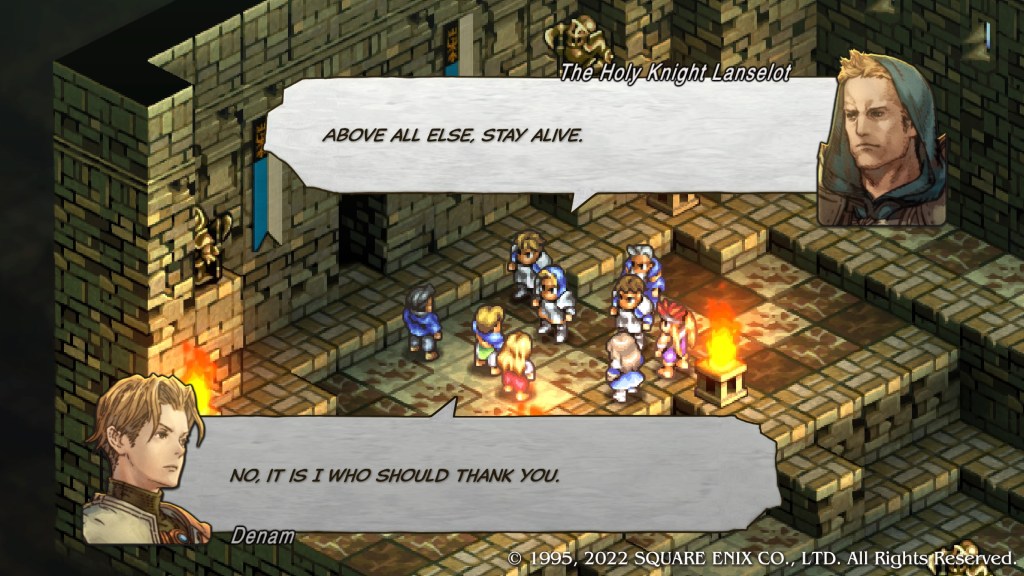
    In my limited free time, I’ve been replaying Tactics Ogre for the PSP. This is one of my favorite games of all time, if not the number one. I originally played it when I was a teenager for Playstation and then years later when I was in college and working as an intern in Washington D.C., playing it on the Bolt Bus between DC and New York.

    I’ve been playing this game on and off for over fifteen years, and I’ve never finished it. The game is non-linear, which I love, and from what I understand, it has multiple endings – none of which I’ve seen. It’s an adult game, with ethical dilemmas that rival modern games like Mass Effect.

    One of the things I’ve found intriguing is the character Lanselot’s mentorship to the main character, Denam. On two separate occasions he lectures Denam on the importance of staying alive above all other things. In one of his first meetings with the main character, he says:

    “So you’re off to aid one of the Duke’s men. I regret we cannot join you. Above all else, stay alive. Win or lose, while there’s life, there’s hope.”

    And then later on, in a quiet moment before one of the game’s pivotal scenes he again advises Denam to stay alive:

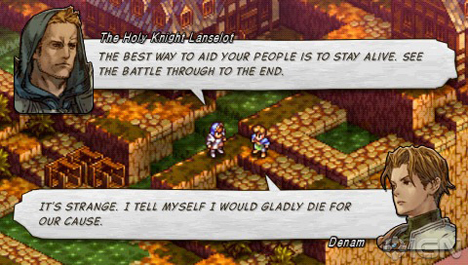
    “Risking your life is one thing. Losing it is another. The best way to aid your people is to stay alive. See the battle through to the end. And there’s your sister to think of.”

    It’s a curious piece of advice in a video game, from a famous warrior. You would expect advice of honor on the battlefield, bravery, or skill. There’s a part of me that thinks the advice might have served as kind of early tutorial in the game. The original Tactics Ogre for Playstation was much more unforgiving when it came to death – if a character was slain in battle he/she was perma-deathed. Lanselot’s advice might have been there to warn the player to protect life, as training a new character was a long and arduous process. The updated version for PSP/Vita still has perma-death, but there’s a timer on the character as in Final Fantasy Tactics.

    Still, whether it served as a tutorial for the player or actual advice, it is refreshing to see it.

    Is it not true?

    Leave a comment


Views my own.


Recent Posts